Bilješka
Pristup ovoj stranici zahtijeva provjeru vjerodostojnosti. Možete pokušati da se prijavite ili promijenite direktorije.
Pristup ovoj stranici zahtijeva provjeru vjerodostojnosti. Možete pokušati promijeniti direktorije.
Applies to: ✔️ Linux VMs ✔️ Windows VMs ✔️ Flexible scale sets ✔️ Uniform scale sets
Important
Azure Virtual Machines HC-series sizes (Standard_HC44rs, Standard_HC44-16rs, and Standard_HC44-32rs) retire on May 31, 2027. After this date, Azure deallocates and stops these VMs, and you can no longer use them. Because the VMs are deallocated, you no longer incur compute charges. HC-series VMs are no longer supported and aren't covered by an SLA after retirement. Sales of 1-year and 3-year Reserved Instances for HC-series ended on April 2, 2026. For migration guidance, see Migrate your HC-series virtual machines by May 31, 2027.
Maximizing HPC application performance on Intel Xeon Scalable Processors requires a thoughtful approach to process placement on this new architecture. Here, we outline our implementation of it on Azure HC-series VMs for HPC applications. We'll use the term “pNUMA” to refer to a physical NUMA domain, and “vNUMA” to refer to a virtualized NUMA domain. Similarly, we'll use the term “pCore” to refer to physical CPU cores, and “vCore” to refer to virtualized CPU cores.
Physically, an HC-series server is 2 * 24-core Intel Xeon Platinum 8168 CPUs for a total of 48 physical cores. Each CPU is a single pNUMA domain, and has unified access to six channels of DRAM. Intel Xeon Platinum CPUs feature a 4x larger L2 cache than in prior generations (256 KB/core -> 1 MB/core), while also reducing the L3 cache compared to prior Intel CPUs (2.5 MB/core -> 1.375 MB/core).
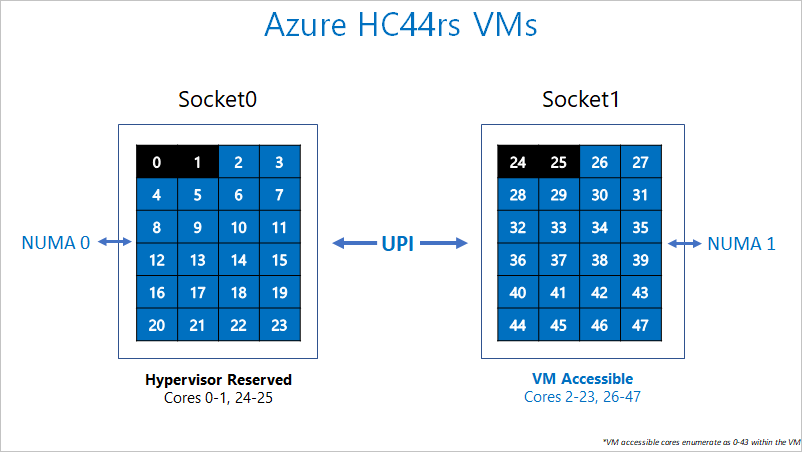
The above topology carries over to the HC-series hypervisor configuration as well. To provide room for the Azure hypervisor to operate without interfering with the VM, we reserve pCores 0-1 and 24-25 (that is, the first 2 pCores on each socket). We then assign pNUMA domains all remaining cores to the VM. Thus, the VM will see:
(2 vNUMA domains) * (22 cores/vNUMA) = 44 cores per VM
The VM has no knowledge that pCores 0-1 and 24-25 weren't given to it. Thus, it exposes each vNUMA as if it natively had 22 cores.
Intel Xeon Platinum, Gold, and Silver CPUs also introduce an on-die 2D mesh network for communication within and external to the CPU socket. We strongly recommend process pinning for optimal performance and consistency. Process pinning will work on HC-series VMs because the underlying silicon is exposed as-is to the guest VM.
The following diagram shows the segregation of cores reserved for Azure Hypervisor and the HC-series VM.
Hardware specifications
| Hardware Specifications | HC-series VM |
|---|---|
| Cores | 44 (HT disabled) |
| CPU | Intel Xeon Platinum 8168 |
| CPU Frequency (non-AVX) | 3.7 GHz (single core), 2.7-3.4 GHz (all cores) |
| Memory | 8 GB/core (352 total) |
| Local Disk | 700 GB SSD |
| Infiniband | 100 Gb EDR Mellanox ConnectX-5 |
| Network | 50 Gb Ethernet (40 Gb usable) Azure second Gen SmartNIC |
Software specifications
| Software Specifications | HC-series VM |
|---|---|
| Max MPI Job Size | 13200 cores (300 VMs in a single virtual machine scale set with singlePlacementGroup=true) |
| MPI Support | HPC-X, Intel MPI, OpenMPI, MVAPICH2, MPICH, Platform MPI |
| Additional Frameworks | UCX, libfabric, PGAS |
| Azure Storage Support | Standard and Premium Disks (maximum 4 disks) |
| OS Support for SRIOV RDMA | RHEL 7.6+, Ubuntu 20.04+, SLES 15.4, WinServer 2016+ |
| Orchestrator Support | CycleCloud, Batch, AKS; cluster configuration options |
Note
Official kernel-level support from AMD starts with RHEL 8.6 and AlmaLinux 8.6, which is a derivative of RHEL.
Next steps
- Learn more about Intel Xeon SP architecture.
- Read about the latest announcements, HPC workload examples, and performance results at the Azure Compute Tech Community Blogs.
- For a higher level architectural view of running HPC workloads, see High Performance Computing (HPC) on Azure.