Note
Access to this page requires authorization. You can try signing in or changing directories.
Access to this page requires authorization. You can try changing directories.
APPLIES TO:  Power BI Desktop
Power BI service
Power BI Desktop
Power BI service
With the relative date slicer, relative date filter, or date picker slicer setting, you can apply time-based selections using a date column. For example, you can show only sales data from within the last 30 days or last calendar month. When you view the report, the relative date period is applied and the specified range filters the other visuals on the page. The Date picker slicer setting (preview) extends this capability by adding a calendar and slider for manual date selection and offering anchor options based on today, the first date, or the last date in your data.

Use the Date picker slicer setting (preview)
The Date picker slicer setting provides relative date selections similar to the Relative date setting, plus a calendar and slider for selecting specific dates or date ranges. Use Date picker when you want both relative options and the ability for report viewers to pick a manual date or date range.
Date picker offers three anchor options for the relative selection:
- Today: The relative range is calculated from the current date when the report is viewed. This anchor uses the same behavior as the Relative date setting.
- Last date: The relative range is calculated from the most recent date in the date column. Useful when your data isn't current or you want the slicer to follow the latest data.
- First date: The relative range is calculated from the earliest date in the date column.
When you set a relative selection like "last full month," the slicer keeps the date range up to date as the anchor date changes. Report viewers can change the relative options when interacting with the report, or select any manual date range or single date using the calendar or slider.

To change the slicer setting to Date picker, select the slicer, then in the Format pane, expand Visual > Slicer settings > Options and select Date picker from the Style dropdown.
Note
Date picker is a preview feature. To enable it, go to File > Options and settings > Options > Preview features and select Date picker slicer.
During preview, you can only create date picker slicers in Power BI Desktop. After you publish a report with a date picker slicer, you can use and edit it in the Power BI service.
Create the relative date range slicer
You can use the relative date slicer just like any other slicer or visual when editing a report in Power BI. Select a Slicer visual to add it to your report page and then select a date column for the Field value. In the following image, we selected the Date column.
Note
If your report has a hierarchy with your data column from the auto date/time feature, the date column itself must be used instead of the hierarchy to use the slicer in relative date mode. To change it to the date column, select the down chevron on the field in the Build well and choose the name of the column instead of the Date hierarchy option.
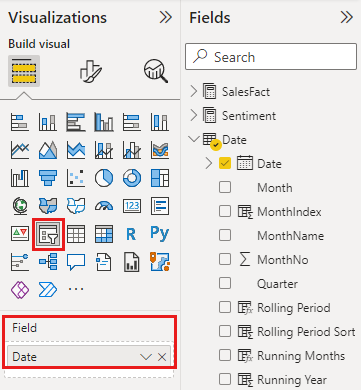
Select the slicer visual, and in the Format pane, under Visualizations > Slicer settings > Options, change the Style to Relative Date.

You can then select the settings in the date slicers. These settings are relative to the day the report is viewed, not the data range in the date column.
For the first setting, you have the following choices:
- Last
- Next
- This
In the screenshot, Last is selected.

In the second (middle) setting in the relative date slicer, you enter a number to define the relative date range. This option is only available for Last or Next, and disabled for This from the first setting.
In the screenshot, 2 is selected.

In the third setting, you pick the date part. You have the following choices:
- Days
- Weeks
- Weeks (Calendar)
- Months
- Months (Calendar)
- Years
- Years (Calendar)
In the screenshot, Years is selected. The settings are read as in the last 2 years and the date column is filtered to only dates in the last 2 years for the other visuals on the report page.

If you select Months instead, to make it the last 2 months, here's what happens:
If today is July 20:
- The data included in visuals constrained by the slicer shows data for the previous two months,
- Starting on May 21 and going through July 20 (today's date).
In comparison, if you selected Months (Calendar), the visuals constrained would show data from May 1 through June 30. The setting corresponds to the last two complete calendar months.
Tip
To avoid showing the partial current month in reports comparing months to prior months, use the months (calendar) setting to ensure only full months are selected.
Create the relative date range filter
You can also create a relative date range filter for your report page or your entire report. To do so, drag a date column from the Data pane into the Filters on this page section or the Filters on all pages section in the Filters pane:

Once there, you can change the relative date range. It's similar to how you can customize the relative date slicer. Select Relative date from the Filter type drop-down.

After you select Relative date, you see three sections to change under Show items when the value, including a middle numeric box, just like the slicer.

Use DAX measures to surface the latest value and its date
If you want to display the most recent value in your data along with the date it corresponds to, you can use DAX measures instead of or alongside a slicer. This approach is useful for card visuals or summary tiles that always show the latest data point.
Use the LASTNONBLANKVALUE function to return the value for the last date that has data, and the LASTNONBLANK function to return that date.
Create two measures:
Latest value returns the value for the most recent date that isn't blank:
Latest Value = LASTNONBLANKVALUE('Sales'[Date], SUM('Sales'[Amount]))Latest date returns the date that corresponds to that value:
Latest Date = LASTNONBLANK('Sales'[Date], SUM('Sales'[Amount]))
Replace 'Sales', [Date], and [Amount] with the table and column names from your model. To give report viewers immediate context about the most recent data point, add the measures to a card visual or display them next to a slicer.
Note
These measures respect filter context. When you add them to a visual with a date axis, each row reflects that specific date's value. When you group by a higher level such as month or year, the measures return the latest non-blank value within that grouping.
Considerations and limitations
The following considerations and limitations apply before showing the relative options in the slicer or filter pane.
- The data type for the column used in the slicer must be a date.
- The date hierarchy for auto date/time in Power BI can't be used. Use the date column directly.
- Date columns in Power BI don't include time zone info.
- When the report is published, slicer and filter relative options are always based on the time in UTC. If you set up a filter in a report and send it to a colleague in a different time zone, you both see the same data.
- The relative week options assume weeks start on Sunday. There's no option to change the start to a different day.